Beverly Nan McNabb
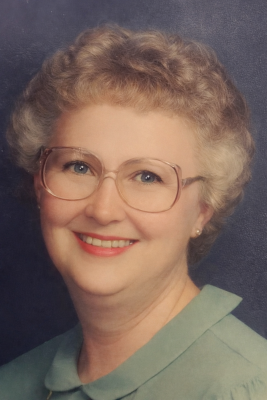
1932 -
I was born on January 9, 1932, in Spearman, Hansford County, Texas. My parents were Ruth Pauline Prutsman McNabb and Warren Gilbert McNabb. I was born in my McNabb grandparents’ home. My parents were living on a farm a few miles out of town.
According to my cousin, Anna Carol Davidson, she was supposed to go to a movie in a nearby town that afternoon but instead got a cousin. She never let me forget it, though she did forget the name of the movie. I became her special person.
My brother, Warren Neil McNabb, was born on January 7, 1934.
This was during the Great Depression of the 1930s. Our younger years were simple. My dad, a World War II veteran, supported his family by being a sign painter and house painter.
In the summers, he would follow the grain harvests, starting in Texas and traveling north—far north one summer to Walden, Colorado. For us kids, those were fun summers. He built a “trailer house” for us to live in. We would travel between small towns and camp along streams.
One memory is of Neil playing with Daddy’s .22 rifle when a bee lit on it. Of course, Neil pinched the bee and got stung.
One year we stopped for the apple harvest. Dad picked apples. Any that had fallen on the ground around the picked areas, Mom and us kids could pick up. I can still remember the smell of all those apples we took back to Texas.
We were camped at Eagle Nest Lake, New Mexico, when we got news of my grandfather’s death—Walter Scott McNabb—in 1936. I suppose someone knew where we were and they called or wired the sheriff’s office, and they found us. We made a quick trip back to Spearman, Texas, and moved in with my grandmother for a few years. Neil and I called her “Mac.”
Later, we moved into a house at the other end of the block. Between the houses was just open space, always with tall grass. It was a good place for us and the neighborhood kids to play.
At the back of her house was a big barn full of stuff. There was a big peach tree at one corner, and along the north side of her house was a row of cherry trees—wild sour cherries. She and Mom would can peaches and cherries for winter pies.
After I started school, we took no more summer treks. We continued to live in the same house. Mom always had a large garden.
I remember one Sunday morning Dad went to town, as always, to buy the Sunday Denver Post. He came home with the news that Japan had bombed Pearl Harbor on December 7, 1941. I had no idea what that was about or where it was. Life changed.
I learned to knit in school to make squares for blankets for the war effort.
The next fall, Dad went to work for the Santa Fe Railroad as a sign painter. We moved to Winslow, Arizona. What a change. Everybody in Spearman had the same color skin as mine—pink. I learned quickly that people come in many different colors.
Neil and I had to walk seven blocks to school. Back in Spearman, we only had a block or two. During those early war years, Winslow continued to grow. The Santa Fe Railroad’s main cross-country tracks ran through the center of town.
We lived in a motel room for the first year, then moved to a little house, which Dad immediately began remodeling. It was closer to the schools too.
Life in Arizona was hard during World War II. Sugar, butter, and gasoline were rationed. Meat wasn’t rationed, but there wasn’t much of it. We walked everywhere and carried paper sacks to bring home groceries.
I remember ration books with coupons for sugar, butter, and gasoline. Oleo was a substitute for butter. It was white, like Crisco, and came with a color packet to mix in so it looked like butter. Mom made cakes using syrup instead of sugar.
Trains full of soldiers came through Winslow many times a day. We, and many others, would go down to the train depot to wave at them. The La Posada Hotel and the depot were close together. We could sit on the rock wall around the hotel and wave.
Dad saved his gasoline coupons so that on Sundays we could drive out into the desert or along the Little Colorado River for a picnic. We picked up lots of rocks and pieces of driftwood. Dad made things with the driftwood. He made several lamp stands.
After the war was over in 1945, we would go south of town to Clear Creek to picnic, then farther into the mountains on picnics or camping trips. Chevlon Canyon was a favorite, as well as Sheep’s Crossing at the headwaters of the Little Colorado River. McNary is the only nearby town I remember.
I was an above-average student but quiet and shy. I was a baton twirler and a drum majorette in junior high and my freshman year of high school. I was also part of a cheering team of about twenty girls. There was a roller skating rink too.
In 1950, after I graduated from high school, Dad transferred to Albuquerque, New Mexico. He and Mom bought a house on Utah Street. I went to business school for a year, then went to work doing clerical work.
I soon met Wylie Edgar Duke Jr. We married on May 3, 1952. We had three children:
Wylie Paul, born February 16, 1953;
Ellen Lucille, born February 23, 1955;
and Laurie Annette, born September 26, 1957.
The marriage failed after a few years, and the kids and I moved in with my folks on Utah Street for several years. That’s when I went to work at Albuquerque National Bank, and after a few years I met another bank employee, Harry Joseph Orr.
When my mother later married Harry Joseph Orr, none of us could have known how much he would change our lives. Looking back now, it’s clear that Harry was a godsend for all of us — for my mom, for my two sisters, and especially for me.
As a teenage boy, I needed the influence and guidance of an adult man in my life, though I didn’t understand that at the time. I see it very clearly now. Harry gave us stability, structure, and a kind of steady love that never wavered. He always told us — individually and together — that he loved us. He never faltered. That consistency mattered more than I understood then.
Harry was an intelligent man — well read, college educated, and deeply curious about the world. Years after he had passed, I was sharing some of my own interests with my mom — ideas about history, the universe, and other unconventional topics — and she told me Harry had been interested in those same things. He read about them and talked with her about them quietly, without an audience. I wish I had known that then. I wish I had him to talk to even now.
Harry had never been around children before he became part of our family, which makes how he handled it even more remarkable. Somehow, he got it right. He was firm when it mattered and fair always. I remember being punished once in junior high — a couple of hard whacks with a board in the garage. It hurt, and it straightened me out. That was the end of it. There was no cruelty, no lingering fear, and it never happened again. After that, discipline meant grounding or losing privileges. He didn’t need to repeat lessons.
We had family dinners at the dining room table every night. That was simply how things were done. After dinner we often played games — Monopoly, gin rummy, and especially cribbage. Harry taught me to play cribbage, and we played a lot. Fifteen-two, fifteen-four, fifteen-six — six is a dozen. I kept my cribbage board on the wall for most of my life. I don’t know where it is now, but the habit of counting and thinking stayed with me.
Camping and outdoor life were a big part of our family. We went on countless camping trips and picnics. Several years we went into the mountains to cut our own Christmas tree. We’d picnic first, search for the right tree, cut it down, and tie it to the roof for the ride home. Once, in a two-wheel-drive Dodge van, we got stuck. Harry was mad and did some cussing, but he wouldn’t let any of us kids get out of the van while he dug it out. That was the only time I remember us ever getting stuck anywhere.
We also had regular picnics — Easter was often spent up on Sandia Mountain below the ski area. Us kids would run all over the place while Harry and my mom stayed back. Years later, my mom remembered those picnics clearly. After reading her story, I realized why: her own father had taken them camping when she was young. Camping wasn’t new to her — Harry brought something back that she already loved.
By the time Harry died, all of us kids were adults and well on our own. It was about twenty years ago now. I can’t really remember what the house felt like without him, which tells me how fully he became part of our foundation.
Looking back, I understand something I couldn’t see as a boy: Harry didn’t save us by doing anything dramatic. He saved us by being steady, fair, and present every day. He showed us what competence, responsibility, and love looked like in practice.
Harry saved us all.